
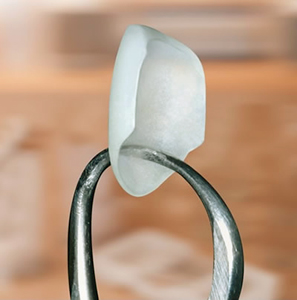
 Ceramic veneers, often also called dental veneers, are thin porcelain shells, about the thickness of a sheet of paper, that are bonded to the front surface of a tooth to improve its cosmetic appearance. Porcelain veneers are typically used to enhance the appearance of teeth that are discolored, worn down, chipped, or misaligned.
What is the role of veneers in modern dentistry?
Porcelain veneers are one of the latest advancements in modern dental science. Materials that provide strong adhesion to tooth enamel have been available to dentists for several decades. The porcelain veneer method utilizes the properties of these materials—allowing the thin porcelain shell (the veneer itself) to be firmly bonded to the tooth. Although porcelain is a brittle material on its own, bonding it to a solid structure like a tooth makes it strong and long-lasting.
What are the advantages of porcelain veneers?
Compared to other types of dental restorations, veneers offer two key advantages:
A) Porcelain veneers give the tooth a natural appearance
You might be surprised to learn that although teeth are mostly made of enamel, this enamel forms only the outermost, hardest layer. One of the main properties of this outer layer is its translucency. This means that when light hits the surface of the enamel, it doesn't reflect back immediately but partially penetrates the enamel layer. The light then reflects off the opaque layer of tooth tissue beneath. This translucency is what gives teeth their characteristic appearance.
Until very recently, all materials used by dentists to improve the appearance of restored teeth were opaque or semi-translucent—meaning that light could not penetrate deeply and was reflected off the surface. As a result, although these materials improved the look of the tooth, they did not fully replicate the appearance of a natural tooth—mainly due to the lack of translucency.
Translucency is the main advantage of porcelain veneers compared to all other bonding materials. When bonded to a tooth, veneers successfully mimic the light-conducting properties of natural enamel. Light that hits the surface of the porcelain veneer penetrates to a certain depth—then reflects off the opaque cement and tooth structure beneath. This translucency creates a sense of depth—making the veneered tooth visually indistinguishable from natural neighboring teeth.
B) Porcelain veneers do not stain
Cosmetic materials previously used in dentistry had another drawback—they tended to stain or lose color over time. This was particularly problematic for those who enjoy tea, coffee, red wine, or tobacco.
Compared to other cosmetic materials, porcelain veneers offer the added benefit that their surface is pure porcelain—a glass-like ceramic material that is smooth and completely non-porous. As a result, veneers do not stain or discolor over time.