
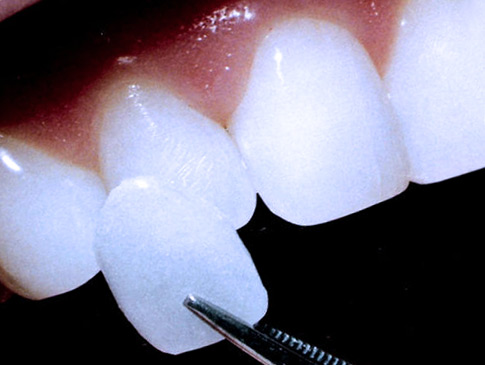
 Before beginning the procedure of applying cosmetic veneers, it is essential to treat all oral diseases and perform professional cleaning of the tooth surface from soft plaque and calculus. Plaque prevents proper bonding between the veneer and the enamel surface and is often the cause of various complications, particularly bleeding gums.
The next step of the restoration is selecting the appropriate color of the future veneers as well as their shape, based on the natural positioning of the teeth and existing defects. A wide color palette and the ability to create veneers in any size allow for highly effective tooth restoration. It is important to remember that veneer restoration is primarily cosmetic, so you will need to avoid intense mechanical pressure on the restored teeth.
If your dentist recommends using the indirect restoration method, after choosing the shade, enamel reshaping is performed, and an impression is taken, which will be used to create the veneers in a laboratory. Indirect restoration can take from several days to a month, as creating cosmetic inserts and treating the teeth takes time. If the direct method suits you, veneers may be applied during the first or second visit to the doctor.
As for the materials used for cosmetic inserts, there are several options, each with its advantages and disadvantages. Your dentist may recommend using composite, which is less expensive and easier to manufacture. However, composite veneers are less durable and require polishing. Additionally, composite veneers tend to lose their brightness over time, unlike ceramic ones.
Porcelain veneers are more durable and do not require polishing. Their appearance is significantly better than that of lower-quality composite veneers. Ceramic materials are more resistant to mechanical stress and offer high translucency, which affects the final color and shine of the treated teeth.
The veneer restoration process involves preliminary enamel reshaping, as the insert has a certain thickness. Once the veneers are ready and the enamel is reduced, the tooth surface is etched to improve adhesion between the enamel and the veneer material.
An adhesive layer is applied to the etched surface, onto which the veneer is placed. It should be noted that the dentist can proceed with veneer installation only after verifying the fit and color of the veneer as well as the correctness of the bite. After bonding the veneer, excess adhesive must be removed and the surface of the newly applied veneer polished.